

OpinionOPINION
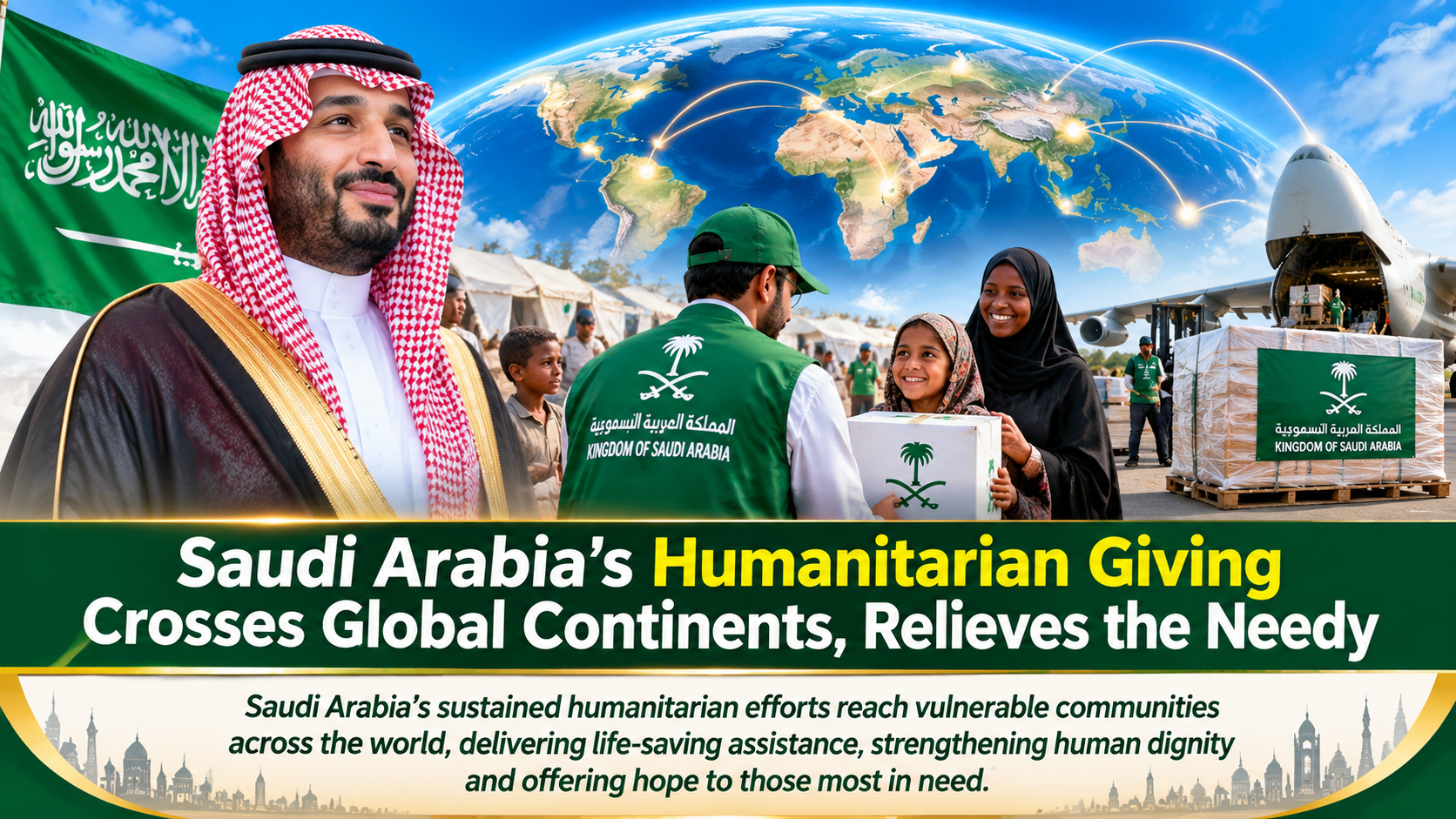
Saudi Arabia’s Humanitarian Giving Crosses Global Continents, Relieves the Needy, and Entrenches Values of Solidarity by Providing $145 Billion Across 175 Countries
Saudi Arabia’s sustained humanitarian efforts reach vulnerable communities across the world, delivering life-saving assistance, strengthening human dignity and offering hope to those most in need.
The humanitarian journey of the Kingdom of Saudi Arabia embodies a story of giving that has spanned since its founding, carrying with it values of benevolence, charity, and solidarity, and extending a helping hand to everyone surrounded by need or facing intense crises. Consequently, the humanitarian and developmental assistance provided by the Kingdom throughout its history has become a testament to its active presence in serving humanity, exceeding $145 billion and encompassing 8,997 projects executed in 175 countries around the world. Through this approach, the Kingdom continues its presence among the largest donor countries, proving that humanitarian work in the Kingdom is not a situational response, but rather a deeply rooted value whose impacts extend across various continents.
This presence translates the support and care that humanitarian and relief efforts receive from the wise leadership—may Allah protect them—which has reflected on the Kingdom's standing in the international humanitarian landscape. The Kingdom achieved the second global rank and first Arab rank among donor countries for humanitarian and relief aid for the year 2025, according to the United Nations Financial Tracking Service (FTS). It also ranked first among donor countries providing humanitarian aid to the Republic of Yemen, accounting for 49.3% of the total aid provided to Yemen—an achievement added to a long record of giving that has made the Kingdom an active partner in facing crises and alleviating the suffering of the affected.
In continuation of this approach, King Salman Humanitarian Aid and Relief Centre was established on May 13, 2015, under the generous directives of the Custodian of the Two Holy Mosques, King Salman bin Abdulaziz Al Saud—may Allah preserve him—to be a leading humanitarian center aimed at providing aid to those in need and rescuing disaster victims anywhere in the world. Since its inception, the Center has implemented 4,425 projects in 113 countries at a total cost exceeding $8 billion. These included the food, education, health, nutrition, water, environmental sanitation, shelter, and other vital sectors, benefiting tens of millions of the most vulnerable groups around the world without discrimination.
The Republic of Yemen stands at the forefront of countries reached by this giving, where the Center has implemented 1,219 humanitarian and relief projects exceeding $4.785 billion in value. This includes qualitative projects, most notably the "MASAM" project to clear Yemeni lands of landmines, which has contributed since its inception to the removal of more than 585,000 landmines, helping to protect civilians and prepare the environment for their return to normal life. Care also extended to children affected by the conflict through the project for rehabilitating child soldiers and those affected by armed conflict in Yemen, "Kafak," which was launched from Marib Governorate in September 2017, focusing on rehabilitating children, returning them to normal life, and providing them with social support as a humanitarian remedy targeting the effects of the crisis on the child's present and future.
In the Gaza Strip, Saudi response continues to alleviate the harsh humanitarian conditions experienced by the residents of the Strip amid the ongoing crisis. KSrelief operated an integrated central kitchen to produce 24,000 hot food meals daily for displaced and affected families, launched numerous educational and developmental projects, and dispatched air and maritime bridges from which 84 planes and 8 ships have arrived so far, carrying more than 7,750 tons of food, medical, and shelter materials. It delivered 20 ambulances to the Palestine Red Crescent Society, signed agreements with international organizations to implement relief projects inside the Strip worth $90,350,000, and carried out airdrops in partnership with Jordan to bypass border crossing closures and ensure aid reaches those affected.
The Center also implemented 523 projects in Syria valued at over $584 million, 353 projects in Pakistan valued at over $228 million, 279 projects in Sudan valued at over $192 million, and 73 projects in Lebanon valued at over $92 million. These projects covered various core relief support sectors.
The journey of medical giving also continues through the Saudi Conjoined Twins Program, whose very first operations began in 1990, completing over three decades of specialized work. During this time, it evaluated 158 cases from 28 countries across 5 continents and performed 72 separation surgeries, all of which—praise be to Allah—were successfully crowned, making the Kingdom one of the world's most experienced nations in the field of conjoined twin separation. The program covers all expenses for surgery, treatment, post-operative rehabilitation, as well as transportation and hosting costs for the twins and their families throughout the medical care period.
This role is not limited to emergency crisis response, but extends to helping individuals regain their lives and self-reliance. The artificial limbs program provides prosthetics to the injured and rehabilitates patients, alongside training local cadres in prosthetic manufacturing techniques. Meanwhile, the Center continues its programs targeting the most vulnerable groups, granting them an opportunity to recover their capabilities and live better lives.
Saudi volunteer work represents another facet of this journey, as KSrelief has implemented 1,435 voluntary programs involving over 84,000 male and female volunteers through the Saudi External Volunteering Portal, benefiting more than 2,800,000 people across 59 countries. Voluntary medical teams have performed over 270,000 surgical operations, transforming volunteers' efforts into field actions that alleviate patients' pain and deliver medical service to those in utmost need.
Among these voluntary initiatives, the Saudi volunteer medical team affiliated with the Center achieved an unprecedented global record by performing 42 cochlear implant surgeries within 14 hours, as part of the "Saudi Hearing" volunteer medical program for cochlear implants and auditory rehabilitation for Syrian children in the city of Reyhanli, Turkey—an achievement combining medical expertise and the spirit of volunteering, granting children a new opportunity to hear and communicate.
On World Humanitarian Day, which coincides with August 19 of each year, the Kingdom recalls a journey of giving that transcended geographical borders and reached individuals in their moments of greatest need. Whether through aid reaching crisis zones, programs restoring patients' ability to live, or volunteers carrying their expertise to those in need, the image of Saudi humanitarian work takes shape, making human beings and their dignity a steadfast focus of its giving.
Inputs From KSrelief
Mohammed AUK
Senior Correspondent — MAUK News
The MAUK Briefing
A concise daily digest of verified reporting, analysis and perspective. No noise.
Comments (0)
No comments yet. Start the conversation.